

1907–1914: artistic recognition
Between 1907 and 1914, Alimondo Ciampi achieved his first full public recognition. During these years he took part in important national and international exhibitions, received significant awards, and defined several of the central themes of his sculpture: childhood, motherhood, portraiture, and the human figure captured in its emotional intensity.
1907 and social themes
In 1907 Ciampi’s attention to anatomy emerged in works still close to the language of social art. Figures such as The Peasant’s Son, Tired Miner and Ciacco portray bodies marked by labor, effort and exhaustion.
At the 60th Exhibition of Fine Arts of the Florentine Society of Fine Arts he presented the bronze Mermaid, the life-size plaster Narcissus, and Milk and Blood!, one of his most important works.
Milk and Blood! addresses the drama of a mother unable to nurse her child:
a powerful image of maternal suffering linked to an experience lived within the artist’s own family.
The 1908 Self-Portrait
In 1908 Ciampi exhibited By the Sea in Florence and presented Without Milk, an alternative title for Milk and Blood!, in Rome.
The most significant work of that year, however, was the Self-Portrait, modeled with broad plastic surfaces and an expressive synthesis that recalls Egyptian and Etruscan sculpture as well as the Tuscan fifteenth century.
Domenico Trentacoste immediately recognized its originality and encouraged Ciampi to continue his artistic path.
Venice 1909
In 1909 the Self-Portrait was accepted at the International Art Exhibition of Venice. It received a highly favorable review from Ettore Cozzani, who described it as one of the finest sculptures of the exhibition.
That same year Ciampi also exhibited in Florence, where Gemmina won the sculpture prize awarded by the Chamber of Commerce.
The Venice Biennale of 1909 marked a decisive turning point:
from promising Florentine sculptor to nationally recognized artist.
Childhood as a theme
From 1910 onward childhood became one of the most distinctive themes in Ciampi’s work. Children are portrayed not merely as graceful subjects, but as living presences capable of expressing wonder, fragility and emotion.
Works such as Child’s Head, Injured Little Foot, Introduction and Ocarina belong to this period.
The studio
A photograph taken by Barsotti shows Ciampi standing beside the plaster of Narcissus, surrounded by many of his most important early works.
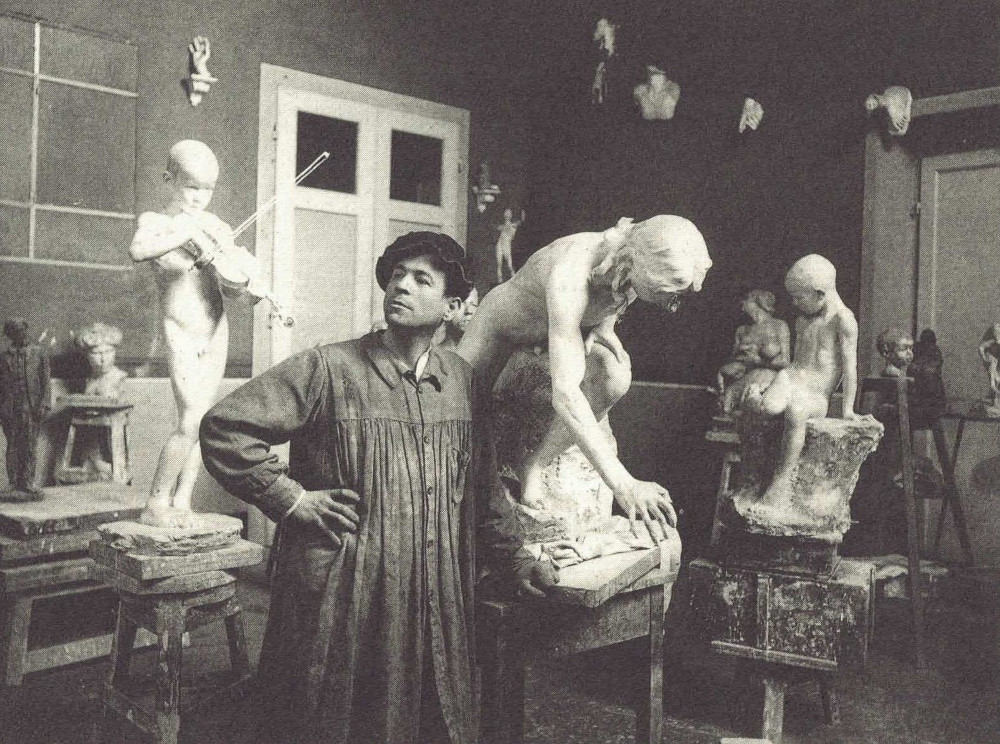
The image captures a moment of intense creative activity, with sculpture, portraiture and childhood already fully established at the center of his artistic universe.
Cultural circles and commissions
Recognition also brought commissions, including the bronze bust of Carlo Baldini for the cemetery of Soffiano.
During these years Ciampi frequented Florentine artistic and literary circles, meeting artists and writers and engaging with the broader cultural environment of the time.
Success in 1912
By 1912 his sculpture was widely appreciated for the quality of its modeling. At Brera in Milan he exhibited Formica, portraying his daughter Gemma while sewing.
The work attracted strong attention and the bronze version was acquired by the King. From this point onward Ciampi was regularly invited to participate in juries and major exhibitions.
The Roman Secession and 1913
In 1913 Ciampi took part in the First International Exhibition of the Roman Secession, presenting the marble Fragment.
In Florence he also exhibited the first bronze version of Ophelia and created two gold medals for the seventieth anniversary of the Florentine Society of Fine Arts.
1914
In 1914 Ciampi exhibited in Florence, Venice, Rome and Milan. He was admitted to the Venice Biennale with Mother!, a marble reinterpretation of Milk and Blood!.
In Milan he presented Prayer, a kneeling child figure that would later inspire several funerary and monumental versions.
On December 27, 1914, Alimondo Ciampi was appointed Ordinary Academician
of the Academy of the Arts of Drawing in Florence.